



By IQBAR Team
Most protein bars were designed with one thing in mind: your muscles. They focus on hitting a protein number, maybe add some fiber, and call it done. What they don't account for is the other organ doing a lot of work during your day — your brain.
What you eat affects how you think, focus, and feel, not just how you recover from a workout. A bar that only supports the body is leaving half the equation unaddressed. Here's what a bar built for both actually looks like.
What Most Protein Bars Get Right (and Where They Stop)
The standard protein bar formula is built around two things: protein and some version of sweetener to make it taste good. Better bars add meaningful fiber. That combination — protein, fiber, low sugar — is a solid foundation. It supports muscle repair, keeps you full, and doesn't spike your blood sugar the way a high-sugar bar does.
But that's where most bars stop. Once the body nutrient boxes are checked, there's usually nothing else in the formula. No consideration for cognitive function, focus, or the nutrients your brain specifically needs to operate well through a long day.
For most people, that gap doesn't matter much when they're choosing between a protein bar and a candy bar. But when you're looking for something that actually supports how you perform mentally as well as physically, the standard formula falls short.
The Brain Nutrient Gap
Your brain has its own nutritional needs, and most of them aren't addressed by a typical protein bar. A few nutrients in particular play a meaningful role in focus, energy, and cognitive function.
Lion's Mane is a mushroom that's been studied for its relationship to nerve growth factor — essentially, the protein your nervous system uses to maintain and develop neurons. It shows up in a lot of focus and cognitive supplements, but almost never in a protein bar.
MCTs (medium-chain triglycerides) are a form of fat the body converts to energy quickly. Unlike longer-chain fats that take time to digest and process, MCTs provide fast-burning fuel that the brain can use directly. They're a common ingredient in products marketed for mental clarity and sustained energy.
Magnesium is involved in hundreds of processes in the body, including nerve function and energy production. It's one of the most common nutritional shortfalls in adults and plays a specific role in how well the brain regulates stress and focus.
Flavonoids are plant-based compounds found in foods like dark chocolate, berries, and certain nuts. They're associated with circulation and have been linked to brain health through their role in supporting blood flow.
Vitamin E is a fat-soluble antioxidant that helps protect cells, including neurons, from oxidative stress. It's found naturally in nuts and seeds and is a standard nutrient in any formula designed with brain health in mind.
None of these are exotic. What's unusual is finding all five of them in a protein bar.
The Body Side Still Has to Work
Adding brain nutrients to a bar doesn't matter much if the core formula is weak. The body nutrients have to hold up too.
Complete protein means the protein source provides all the essential amino acids your body can't make on its own. Plant-based proteins can absolutely deliver this, but not all of them do — it depends on how the protein is sourced and whether the amino acid profile is complete. A bar positioned as high-protein needs to back that up with a source that actually does the job.
Prebiotic fiber is the other piece. Most bars that include fiber use it primarily as a filler. Prebiotic fiber specifically feeds the beneficial bacteria in your gut, which is a different and more functional role. The gut-brain connection is well established — what happens in your digestive system affects how you feel mentally as well as physically. Fiber that supports the gut microbiome is doing more work than fiber that just adds bulk.
The two sides — brain and body — work together. A bar that only addresses one of them is still a partial solution.
What IQBAR's Formula Looks Like
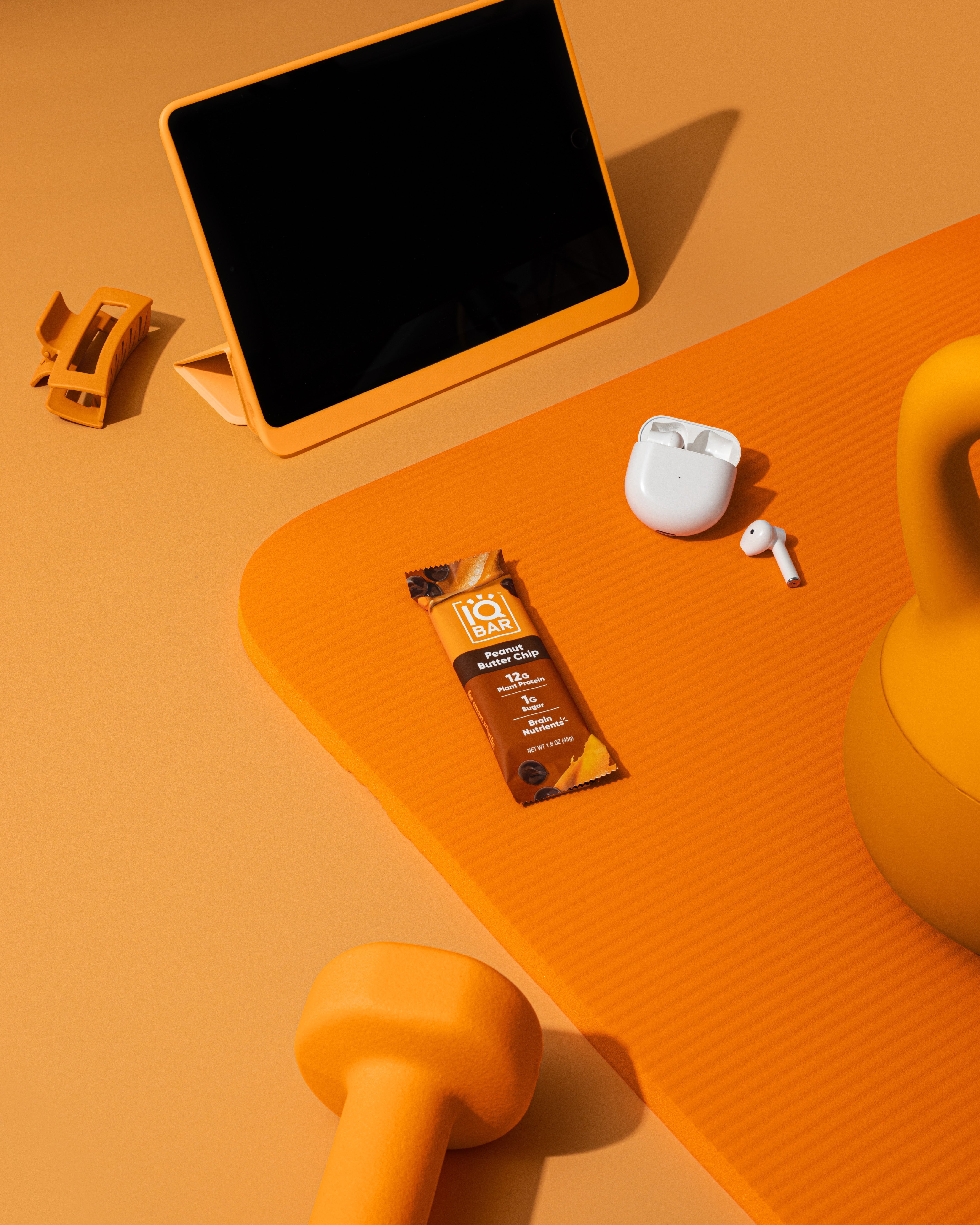
IQBAR is built around the combination of brain and body nutrients in a single bar. On the body side: 12g of complete plant protein and 6-9g of prebiotic fiber per bar. On the brain side: five nutrients — Lion's Mane, MCTs, Magnesium, Flavonoids, and Vitamin E — added to every flavor.
The sugar content is 1-2g total, with no added sugar. The bar is dairy free, soy free, vegan, gluten free, Non-GMO Project Verified, and Clean Label Project Certified, meaning it's been independently tested for heavy metals and contaminants — not just marketed as clean.
It was built on the premise that most protein bars are one-dimensional. They support your workout or your hunger, but they don't think about the person eating the bar at 2pm trying to stay sharp through a long afternoon.
Frequently Asked Questions
Do protein bars with brain nutrients actually work?
The nutrients themselves are real and well-studied individually. Lion's Mane, MCTs, Magnesium, Flavonoids, and Vitamin E all have established roles in brain function, energy, or cell protection. Whether you notice a difference depends on your baseline — people who are already deficient in something like magnesium are more likely to feel an effect than someone whose levels are already optimal. Either way, including them in a bar you're already eating adds nutritional value without any trade-off.
What brain nutrients should I look for in a protein bar?
The five most useful ones to look for are Lion's Mane, MCTs, Magnesium, Flavonoids, and Vitamin E. Most bars don't include any of them. A bar that includes all five, alongside a complete protein source and meaningful fiber, is addressing both the body and the brain in one package.
Is plant protein as good as animal protein for muscle support?
Yes, when the protein is complete, meaning it contains all essential amino acids. Not all plant proteins qualify on their own, but a well-formulated plant-based bar can provide complete protein just as effectively as one made with animal sources — while also being dairy free, soy free, and better suited for people with common sensitivities.
What's prebiotic fiber and why does it matter?
Prebiotic fiber feeds the beneficial bacteria in your gut rather than just adding bulk. A healthy gut microbiome is connected to everything from digestion and immunity to mood and cognitive function. Most bars use fiber as a filler. Prebiotic fiber is doing more specific and functional work.
How is IQBAR different from a standard protein bar?
Most protein bars focus only on protein and treat everything else as secondary. IQBAR includes five brain nutrients alongside 12g of complete plant protein and 6-9g of prebiotic fiber, with 1-2g of total sugar and no added sugar. It's also Clean Label Project Certified, which means independent lab testing — not just a marketing claim.
The Bottom Line
A protein bar that only supports your muscles is doing half the job. Brain nutrients — Lion's Mane, MCTs, Magnesium, Flavonoids, and Vitamin E — address the other half. Combined with complete plant protein and prebiotic fiber, that's a formula built for how people actually use their bodies and minds through a full day.
If you want a bar designed for both, IQBAR is worth trying.